I. Function Overview
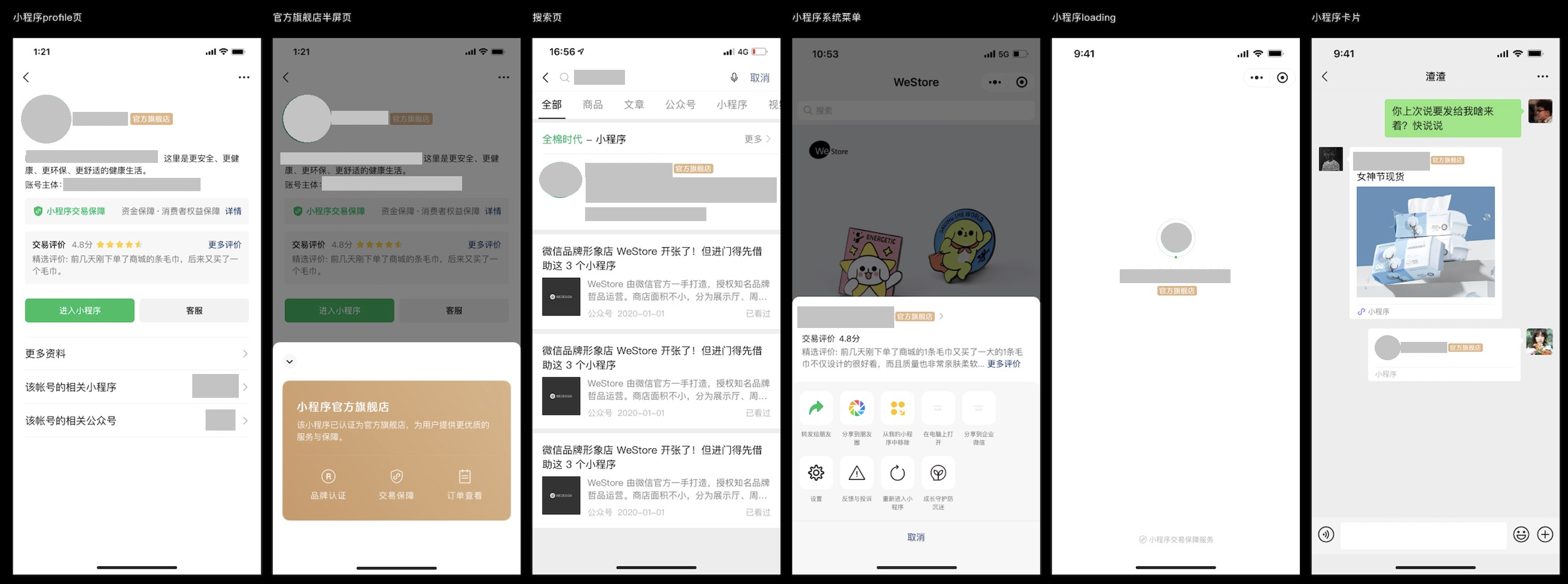
An official flagship Mini Program refers to a high-quality enterprise Mini Program launched and operated under a proprietary brand (with an “R” or “TM” mark) or with authorization from the trademark owner. It is officially recognized by WeChat, enabling users to easily identify such programs.
II. Application Requirements
To apply for the official flagship status, the following three criteria must be met:
- Possession of direct-operated or authorized trademark rights;
- Activation of the transaction protection service;
- Setting up a “Mini Program Order Center” page.
Notes:
- The brand must be unique, with only one store per secondary category allowed.
- Unverified Mini Programs cannot use names like “Official Flagship” or “Flagship”.
- These are merely application requirements; final approval is subject to platform review. (For review criteria, see point IV.)
III. Application Process
-
Activate Transaction Protection Service If your Mini Program meets the transaction health standards, you can apply. For details, refer to Transaction Protection Service Product Description.
-
Set Up Mini Program Order Center Go to Mini Program Management Backend → Settings → Service Content Declaration → Set the path for the Mini Program Order Center.
-
Brand Certification In the Mini Program Management Backend → Features → Transaction Protection → Official Flagship Page, submit brand certification documents.
Notes:
- After completing these steps, log in to the WeChat Open Platform using your Mini Program credentials. Navigate to “Features → Transaction Protection → Official Flagship” to submit the application.
- Since the official flagship status requires the transaction protection service, once your account meets the requirements, the application form will appear in the Mini Program Management Backend. If it’s not available, first activate the transaction protection service. For more details, see Transaction Protection Service Product Description.
IV. Review Criteria
The official flagship Mini Program program aims to select those that represent excellence in quality and trustworthiness. In addition to basic qualifications, the platform evaluates applications based on multiple criteria, including:
- Brand Foundation: Establishment time, physical presence, and supply chain maturity.
- Market Influence: Accreditations, industry reputation, and cross-platform performance.
- Business Health: Sales across channels, customer feedback, and service stability.
V. Brand Certification Guidelines
1. For Proprietary Trademarks:
- Provide the account holder’s Business License and Trademark Registration Certificate.
2. For Authorized Trademarks:
2.1 If the trademark owner is a mainland entity:
- Account holder’s Business License and Trademark Registration Certificate.
- Authorization letter from the trademark owner detailing the brand authorization. Template available here
2.2 If the trademark owner is not a mainland entity and the accounts are affiliated (e.g., parent-child or directly controlled):
- Account holder’s Business License and Trademark Registration Certificate.
- Authorization letter from the trademark owner. Template available here
2.3 If the trademark owner is not a mainland entity and there is no affiliation:
- Account holder’s Business License and Trademark Registration Certificate.
- Authorization letter from the trademark owner.
- Depending on the trademark owner’s nationality, provide one of the following certifications:
- Trademark registration certificate and Trademark Use License filed with the Chinese Trademark Office.
- If the country isn’t a signatory to the Hague Convention or the convention isn’t in effect, provide:
- Trademark registration certificate and authorization letter.
- Notarized copy of the authorization letter by a local notary.
- Certified translation by a designated Chinese institution, along with a statement confirming its accuracy.
- Legal verification of the trademark authorization by a lawyer licensed in mainland China, including:
- Lawyer’s verification of the agreement and legality of the authorization.
- Lawyer’s license from a domestic law firm.
- If the country is a signatory to the Hague Convention, provide:
- Trademark registration certificate and authorization letter.
- Notarized copy of the authorization letter by a local notary.
- Additional certification issued by the relevant authority, along with a certified translation and confirmation of its accuracy.
- For Hong Kong, Macao, or Taiwan entities:
- For Hong Kong companies: Trademark registration certificate and related documentation from the Chinese Trademark Office; or notarized authorization letter with verification by a Hong Kong notary and confirmation by a Chinese legal firm.
- For Taiwan companies: Similar documentation as above.
- For Macao companies: Similar documentation as above. Note: Only trademarks registered with the Chinese Administration for Industry and Commerce are accepted. Text-based trademarks or those with primarily textual elements are permitted; graphic-only trademarks are not accepted.